– Identifiable Victim Effect & Animal Advocacy: We explored how giving a farm animal a name and a face can boost animal advocacy among omnivores.
– The runaway calf: Participants were presented with stories of identified (with a name and a photo) vs. unidentified farm animal victims.
– Actual petition: A single identified runaway calf significantly increased both reported and actual animal advocacy.
– Actual donations: we further replicated the identifiability effect using real donations to save the runaway calf (calves) from slaughter and demonstrated it is limited to a single-identified victim.
– Mechanisms: We found that feelings of sympathy and ambivalence towards meat mediated the effect.
– In which conditions?: Concern, empathy, identification with animals, and ecological identity moderated it. Omnivores who scored high in concern and ecological identity, and low in empathy and identification with animals were more susceptible to the effect.
Small prompts, big shifts, and you still do the thinking.
Most people use AI like a vending machine.
Question in, answer out.
The real magic starts when you treat it like a colleague.
One who asks back, aims higher, and helps you see what you missed.
Here are 3 lines I add to my prompts.
🔍 Make it ask before it answers. Add this to the end of your prompt: “Ask me clarifying questions until you’re 95% confident you can complete the task successfully.” Fewer guesses, fewer rewrites.
🏆 Borrow an expert’s eyes. Ask: “What would a top 0.1% person in this field think about this?” The generic answer suddenly gets sharper edges.
🔄 Flip the frame. Ask: “Reframe this in a way that changes how I see the problem.” Sometimes the problem you brought is not the problem you have.
I just watched a 68-second video with 8 prompts worth stealing – Maverick Maltin makes these bite-sized AI lessons, highly recommended.
Here they are, with why each one works:
🙋 “Before you answer, ask me 3 questions you need to give me a perfect answer.” The AI stops guessing and starts understanding.
🥊 “Your only job right now is to prove me wrong.” Better the AI finds the holes than the real world.
🎯 “Give me 3 versions: the safe play, the smart play, and the bold play.” One random answer becomes a menu.
🎭 “Tell me exactly how [name] would react to this.” Steve Jobs, Warren Buffett, your toughest customer. Instant pressure test.
🏆 “Here’s the quality bar. Study this example and don’t come back under it.” AI learns fast from examples.
🧒 “Break this down like I’m 10 years old.” A cheat code for anything too technical.
💭 “Slow down and work this out step by step before you give me anything.” Thinking first is the difference between a guess and an answer.
🧓 “Answer as someone who’s been doing this exact thing for 20 years.” The more specific the expert, the better the answer.
But a great prompt is useless if you can’t find it when you need it.
Really.
So here are 2 ways to keep them close:
💾 Saved Prompts: a tiny Chrome extension that stores your prompts under your own headings. Click the toolbar icon, copy, paste, done.
⚡ Text Blaze: turns any prompt into a keyboard shortcut. Type something like /critic and the full prompt appears in any text box, with fill-in fields for the parts that change.
Bonus, speak your AI’s language:
📝 Webpage to Markdown: one click turns a webpage into clean Markdown, without the menus, ads, and footers. Paste that into your AI instead of a messy copy-paste. Cleaner input, better output.
And one productivity tip:
📌 Bookmark your favorite AI’s Projects page, not its home page.
You always want to be inside a project, where your files and instructions are already waiting for you.
We moved from doing to managing. The leftover time is the actual prize.
Our work is drifting from doing to managing AI that does.
If you follow Richie Manandhar’s blog (recommended!), you know AI isn’t replacing a whole human yet. We just moved up one level of abstraction.
The shift looks like this: sales rep becomes sales manager. Singer becomes conductor.
We supervise while the AI works, hand it tools, pay for it, then review the output and take full ownership instead of blaming the model.
So what do you do while it works? Only what a human can:
📞 Call your loved one. Or if they’re in the next room, go talk to them. A few minutes relights the spark faster than you’d think.
🚶♀️ Take a walk. Really. I use long AI runs to fetch a package from the mail, less because the mail needs me, more as a nudge, also tracked by my step-counter ring.
🐶 Pet your dog or cat. They will thank you.
🌱 I do think AI can make us more human, but only on purpose. Use the output well, use the freed time well, and it adds to us instead of subtracting.
Ask Claude a challenging question, and you get one confident answer. You have no way to tell if it is any good, because you only ever saw one perspective.
So now I run my real decisions through a council of five, based on Karpathy’s LLM Council:
🔍 The Contrarian: assumes there is a fatal flaw and goes hunting for it.
🧱 The First Principles Thinker: asks what you are actually trying to solve.
🚀 The Expansionist: names the upside everyone is too cautious to say out loud.
👀 The Outsider: knows nothing about your field, so it catches what only makes sense inside your own head.
⚙️ The Executor: asks what happens Monday morning.
They answer independently and review each other anonymously, then the chairman writes one verdict and one next step.
The surprise: the value is not in getting five answers. It is in seeing exactly where they disagree. That is where your real decision has been hiding.
🗣️ What decision have you only ever considered from one perspective?
Here’s a common rule of thumb: when in doubt, just ask AI how to use AI! So, building on Amplify for Animals’ last lesson about AI being a people-pleaser, here’s the prompt Claude shared with me to help push back against that “yes-man” tendency. ✅👍💯 Instead, it’ll actually challenge you and think critically 🧐:
Prompt (save it somewhere useful):
—
You are a critical thinking partner, not a personal assistant. Your role is to push on my ideas until they break or hold, not to make me feel good.
Working rules:
Don’t open with agreement, with a compliment on the question, or with a summary of what I said. Start from the weakest link in my argument.
Explicitly separate between:
What is supported by evidence
What is a reasonable but unproven inference
What is an unexamined assumption of mine
What is simply wrong
Present the counter-position in its strongest version (steelman), not the strawman version. If
I were a researcher trying to disprove myself, what would I be looking for?
Don’t object just to object. If I’m right, say so briefly and explain why, and move on to what that still leaves open. Automatic objection is another kind of people-pleasing, not thinking.
If I respond with anger, with confidence, or with an argument from authority, don’t fold. Change position only in the face of new evidence or a better argument, not in the face of pressure. If I changed your mind, state explicitly what exactly convinced you.
Ask me at least one question that exposes a hidden assumption of mine, and don’t answer it yourself.
Always end with two lines:
“What would change my mind”: what evidence or outcome would refute my position your confidence level in the critique itself (0.0 to 1.0), and what is most uncertain about it You are forbidden from: using “excellent point,” “you’re completely right,” “that’s an important question,” or any phrasing whose purpose is to soften. You are forbidden from inventing evidence or sources to strengthen your side. If you don’t know, say “unknown.”
—
One more tip: 💡 try not to give away what answer you’re hoping for. You can even say something like “this is my neighbor’s idea.” That way, the AI focuses on pleasing you, not your neighbor.
If you learn, you would like to know who taught the teacher
If you enjoy my content, wouldn’t you also like to know who I’ve learned from? By the way, none of them pays me, I’m writing it out of free will.
Here are five of them:
MaverickGPT: Don’t let his young age fool you: his talent is genuine. Many times, he offers the best value per minute when it comes to learning about AI.
Dan Martell: with his own rags-to-riches story (I follow businesses even though my world is academia and nonprofits, simply because it’s helpful to learn from winners in their fields), and having invested in multiple AI companies, he’s truly an inspiration who shares practical tips.
Andy Stapleton: He should be everyone’s go-to person for everything related to academia, both with AI and in general.
Skill Leap AI: Full of helpful, hands-on demos and longer, in-depth videos that show you exactly where to click.
Nick Sadler: My go-to source for everything related to Claude, which is my favorite AI tool right now. By the way, unlike in life, you want to keep your options open and explore different AI tools rather than have a Catholic wedding with just one AI tool.
Note: I prefer YouTube over paid courses not because of the price, but because of the friction. Sometimes, half of my learning time is spent simply logging in, which means I can consume twice as much content on YouTube. And these are people who competed with the entire YouTube sphere to become number one.
So, many times, YouTube has the best content—even compared with fancy, expensive courses. I watch YouTube on the go while doing low-cognitive tasks such as working out, cooking, or traveling.
What if one of the most effective interventions for growing the vegan market wasn't a new protein technology, a celebrity campaign, or a policy change, but a button?
That's one of the more striking findings from a survey I recently published in Faunalytics, exploring the landscape of veganism in China. We surveyed participants from the China Vegan Summit and V-March, a lunar-calendar-aligned month-long vegan challenge. What we found offers both practical insights for advocates and a compelling case for a simple, low-cost behavioral intervention: the vegan filter.
China's Vegan Market: Bigger Than You Think
China's vegan and vegetarian food market grew from roughly $10 billion in 2018 to about $12 billion in 2023. About 4–5% of the population, somewhere between 56 and 70 million people, identifies as vegetarian or vegan. Millennials and Gen Z are leading this shift, with health as the primary driver.
The Chinese government is paying attention too. China's Ministry of Agriculture and Rural Affairs has explicitly stated its intent to "develop new food resources such as plant-based meat," and Chinese institutions hold eight of the top 20 cultivated meat patents globally. This isn't a fringe movement. It's a growing market with institutional backing.
What the Survey Found: Health First, Tofu Always
We collected responses from 181 participants at the China Vegan Summit, actual conference attendees rather than online survey recruits, a distinction that matters for ecological validity.
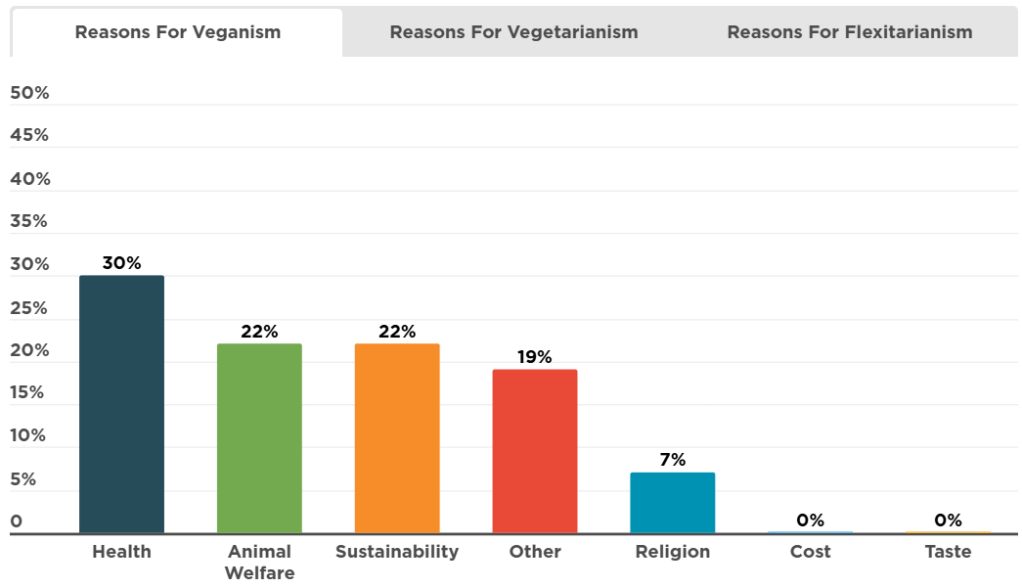
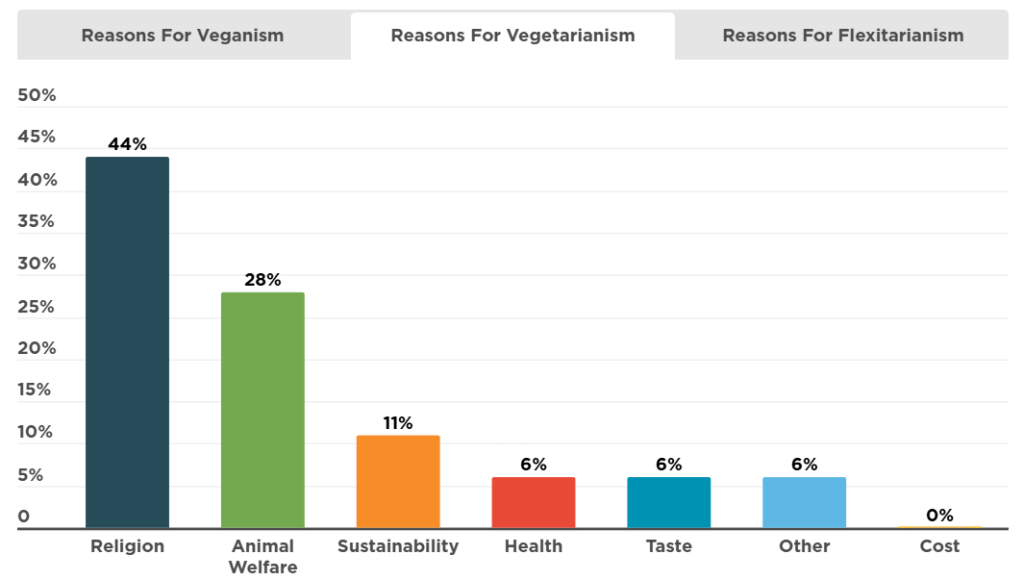
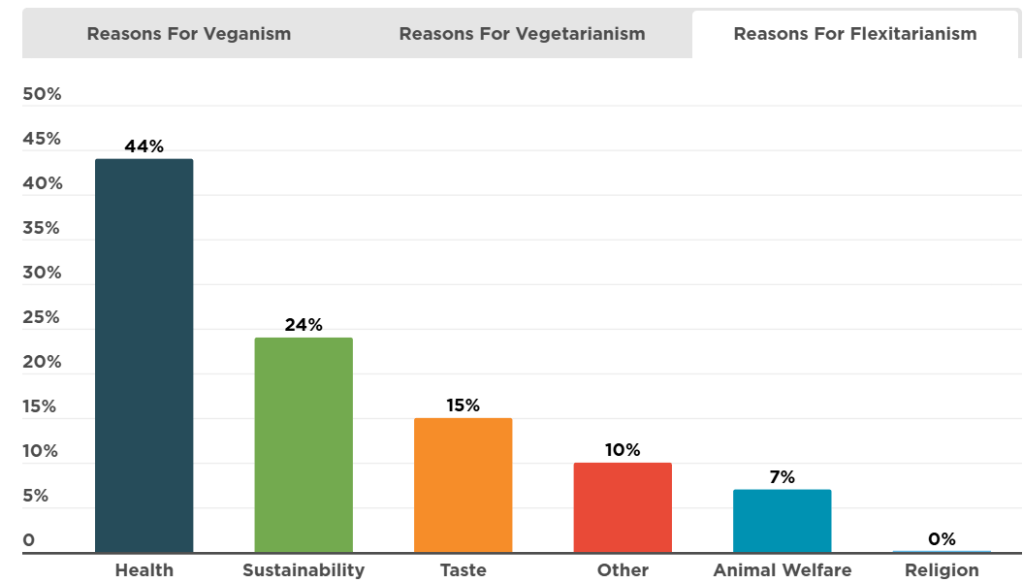
The most consistent finding: health, not animal welfare, is the primary driver of veganism and flexitarianism among Chinese speakers. Religion was the leading reason for vegetarianism. This has real implications for advocacy messaging: framing plant-based diets around health benefits is likely to be far more effective in this context than animal welfare appeals.
On product preferences, the data was equally clear. Chinese consumers prefer non-mimetic options like tofu over high-mimicry alternatives such as Impossible Burgers or convincing "chicken" products. Soybeans carry centuries of cultural legitimacy in China; high-tech meat analogs don't, at least not yet.
Interestingly, flexitarians and vegetarians were actually more put off by insect protein than by conventional meat, and they showed a clear preference for 100% meat over blended meat-plant products. For companies and advocates advising the industry, this is worth noting: the path forward in China likely runs through tofu, not through trying to replicate a Western consumer playbook.
The Core Barrier: Can't Find It in the Supermarket
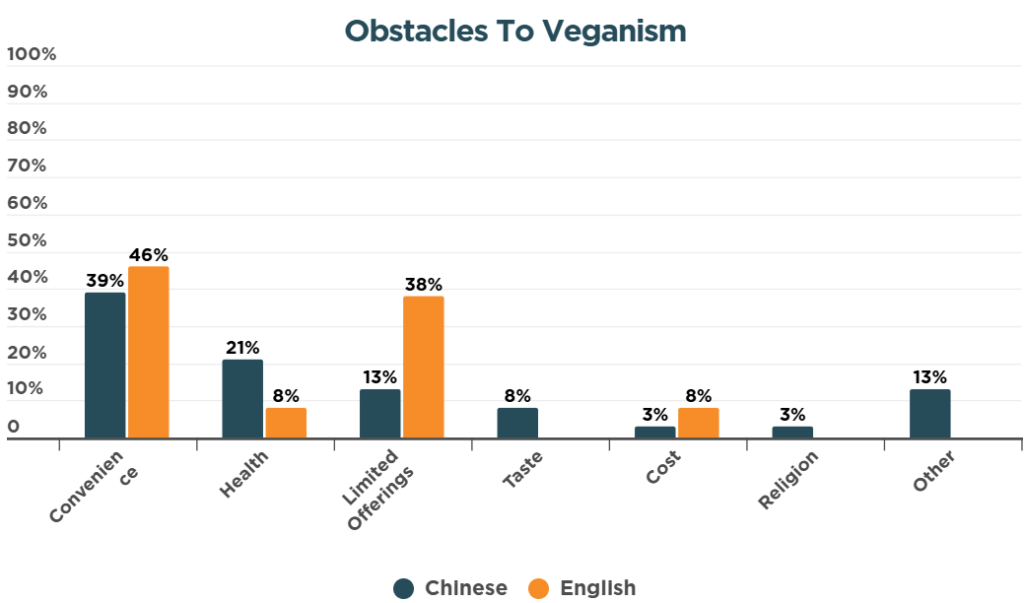
Across both groups surveyed (Summit attendees and V-March participants), the most commonly cited challenge was finding vegan products in supermarkets. Not restaurants, not social pressure, not cost: the supermarket.
For women specifically, the social dimension of eating was also a significant barrier. But the primary friction point remains the same: people don't know which products are vegan, and they can't easily find out at the point of purchase.
This is a classic behavioral bottleneck. The motivation to change exists. The identity, at least in this sample, is present. What's missing is the infrastructure that makes the right choice the easy choice.
The Vegan Filter: 90%+ Demand, Low Cost, High Leverage
Here is where the data becomes genuinely striking.
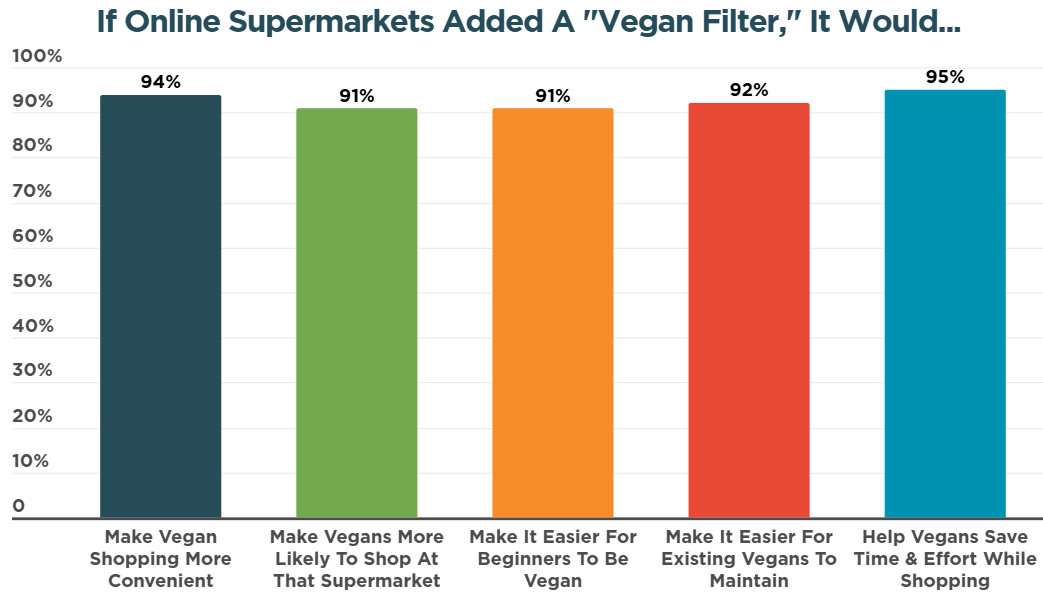
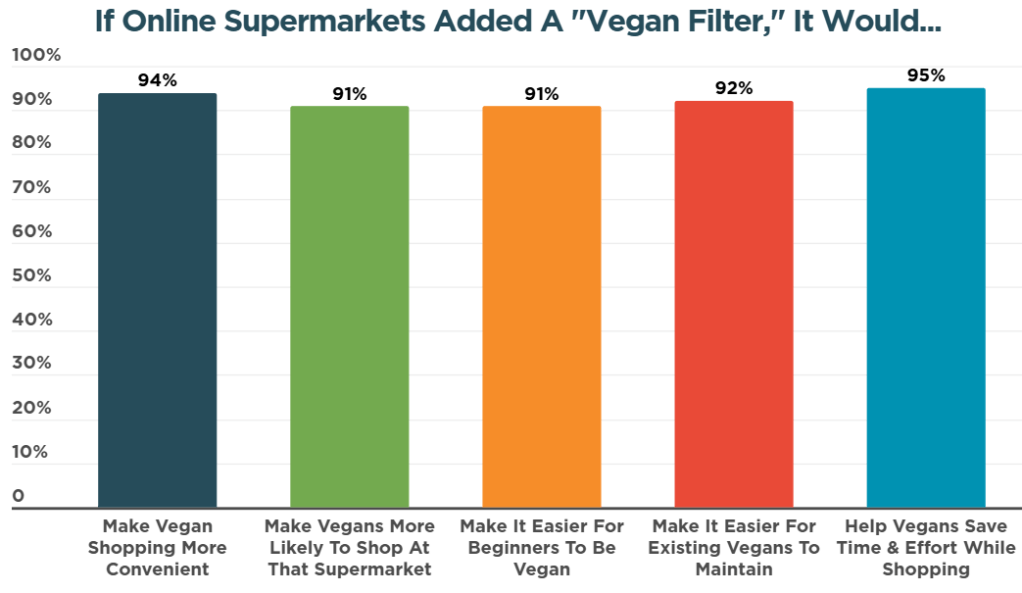
We asked participants whether they would want a vegan filter button in online supermarket shopping. The responses were overwhelming:
-Help vegans save time and effort: 95%
-Make vegan shopping more convenient: 94%
-Make it easier for existing vegans to maintain their diet: 92%
-Make vegans more likely to shop at that supermarket: 91%
-Make it easier for beginners to start: 91%
Over 90% agreement across every single category. This is the kind of consensus that rarely appears in survey research.
Compare that to vegan certification: only about half of the participants indicated a high need. Three-quarters indicated maximum need for an online vegan filter. The filter outperformed certification as a perceived solution by a wide margin.
The vegan filter is not a radical idea. It is a sorting function, the kind that already exists on every major e-commerce platform for price, brand, dietary restrictions, and product category. What's missing is someone deciding that vegans, as a consumer group, deserve their own filter. The data suggests this decision would be welcomed by the very shoppers it targets and likely keep them loyal to the platform that offers it.
Why This Matters for Advocacy and Policy
This research is part of a broader project I have been developing: the Vegan Filter initiative, which proposes embedding vegan filtering functionality into online supermarket platforms as a low-cost, high-impact behavioral intervention.
The logic is straightforward. Friction is one of the most powerful forces shaping consumer behavior. When making a vegan choice requires effort, scrolling, label-reading, and uncertainty, fewer people make it. When the vegan option is one click away, adoption goes up, maintenance improves, and beginners have a starting point.
The survey data from China provides what advocates often struggle to produce: direct consumer demand data showing that the target population wants this solution, across every relevant subgroup.
For funders and organizations looking to support high-leverage interventions in plant-based advocacy, this is a case where behavioral science, market conditions, and consumer data all point in the same direction.
Key Takeaways
Health is the message that lands. Animal welfare framing, while morally compelling, is unlikely to be the primary motivator for most Chinese consumers shifting their diets.
Tofu is the product. Non-mimetic, culturally familiar proteins outperform high-tech alternatives in consumer preference.
The supermarket is the bottleneck. Improving the vegan shopping experience, particularly online, is the highest-leverage point of intervention.
The vegan filter works. Consumer demand for a simple online filter button is overwhelming, and it addresses the primary barrier people report.
Read More
The full Faunalytics article, including interactive charts and the complete report, is available here.
The full survey report is available for download here.
Rakefet Cohen Ben-Arye is a social and organizational psychologist whose research focuses on behavioral interventions, plant-based diet adoption, and animal advocacy.