Bright-Line Rules for Goal Setting

You have the right to remain silent.

Forgetting to recite the complete Miranda rights led to a legal victory and established clear guidelines for setting effective goals.

Bright-line rules, drawn from legal principles, establish clear, unambiguous boundaries, similar to Miranda rights.

Rather than setting vague goals like "eat better," create specific rules such as "eat two servings of vegetables daily" or "place two fruits from the fridge into a bowl on the counter after brushing my teeth."

Instead of saying "I want to improve my sleeping habits," commit to "I will be in bed by 10:30 PM every night."

Rather than stating "I want to be more productive," declare "I will focus on my highest-priority task for 20 minutes immediately after opening my laptop in my office."

These rules, preferably including specific times and locations (with reminders as needed), help form new habits and reduce the mental strain of constant decision-making.

This approach shifts your energy from making repeated choices to simply following predetermined guidelines.


Save more with cyclic saving

Psychology have something to say about how to save more with cyclic saving type of thinking:

• Focus on the process of saving, not just the end goal.

• Think cyclically: if you save now, you'll likely save next month. Current actions predict future actions.

• A 2014 study showed that cyclical savers saved 78% more than linear, future-oriented savers.

• Treat saving like a regular habit, such as flossing or paying bills.

• Make saving a recurring behavior instead of a means to a specific end

AI can clone you – make it work for you

✨Exciting news – now Claude can clone you!

Its agent-like features enable it to do your work for you while you're away, asleep, or working on other tasks.

Imagine your most tedious, mind-numbing tasks – the ones that are unimportant but urgent. These are the tasks you would like to automate.

Here are some things it can do for you:

• Analyze data

• Create visualizations

• Work with files

Here are 5 potential ways nonprofits could leverage this capability:

📊 Data Analysis Automation: Process and analyze large datasets of donor information or program outcomes without manual spreadsheet work

📈 Impact Reporting: Generate custom visualizations and reports by having Claude analyze program data and create charts/graphs

📁 Grant Application Support: Analyze past successful applications and program data to help strengthen new proposals

📩 Donor Communications: Process donor engagement data to identify trends and create personalized communication strategies

🔍 Research Synthesis: Quickly analyze and summarize multiple research papers or reports to inform program development

To get started, you'll need to:

• Install Docker

• Have a paid Claude subscription

• Set up a Claude API account (separate service with its own fees)

Let me know if you plan to use it!

AI for academia: 3 Andy Stapleton videos + a bonus

Hey everyone, I wanted to recommend 3 Andy Stapleton videos about AI, mostly for academia + a bonus:

Notebook LM: This tool is fantastic for literature reviews. It can handle up to 50 sources for free!

Chat GPT vs. Perplexity: It turns out that Perplexity gives Chat GPT a good fight! TL;DR: Chat GPT excels at data analysis, writing, and editing, while Perplexity shines at finding references, 20 in this demonstration, and directing to the right ones, in addition to summaries and chats when asking for help.

SciSpace: This tool is similar to Jenni AI, helping you overcome writer's block. It auto-completes sentences with references, so you never start from a blank page gain. But SciSpace also does so much more!

Bonus recommendation:
-I found an excellent free R course on YouTube. Sometimes these free resources are even better than paid courses!

Let me know if you check any of these out – I'd love to hear your thoughts!

Recommended AI tool for academia – chat with multiple pdfs

A powerful tool for academia. Students and researchers often seek AI tools to simultaneously engage with multiple papers or pdfs. Enter Documind, which does precisely that.

Andy Stapleton, a go-to YouTuber for academics, even covered it in his video. Documind eliminates the need to repeat questions with each new pdf upload. This streamlines the literature review process, saving valuable time and effort. The potential of this tool is truly impressive!

Never miss twice

So often, we mistakenly believe that maintaining good habits is an all-or-nothing game. However, instead of aiming to never break the chain, we should focus on never missing twice.

The first mistake isn't the crucial one. The second mistake is.

Missing once happens. Missing twice is the beginning of a new habit.

The Power of Shrinking the Gap Between Thought and Action

How often did you procrastinate on a task only to realize later that it was easier than you thought?

You can significantly enhance productivity by minimizing the time between recognizing a task and taking action.

The task will often take you less time and trouble than you thought when delaying it. This is why you had better take action once the problem arises.

By engaging in action, it allows for a step-by-step problem-solving process.Pushing off tasks creates a cycle of avoidance, making you more likely to procrastinate.

Personal power is defined by the reduced distance between thought and action.

An omnipotent can think of something, and it becomes a reality. So, if we want to be more potent, this is what we need to aim for.

Snipped from Modern Wisdom – #830 – Alex Hormozi – 24 Controversial Truths About Success & Failure. Via AI-powered podcast app Snipd.

Social psychology fitness hacks

With the mind-body connection in mind, which I consider inseparable, I'd like to suggest two practical fitness tips based on social psychology and personal experience:

– Use a step counter app (try this one or that one, both are supposed to have a free version). For more advanced users, consider buying a smartwatch or smart ring like I did. It can cost as little as $34 and is worth the investment. In my experience, it not only encouraged me to take more steps but also gave me a "winner effect." This means that a person who starts winning for any reason tends to keep winning. I didn't only change my behavior; I also reframed what I would have seen as time-wasting chores as winning by counting steps. This mindset made my working day more productive.

– Invest in dumbbells or TRX equipment. I use dumbbells as they're the simplest way for me to do strength training. It will save you the psychological friction. There's no need to sign up for a gym, change clothes, travel there, or do enough exercise to justify the whole process. Just place them somewhere visible at eye level and commit to doing 12 reps whenever you see them. It's a bite-sized approach.

Recommended AI and Productivity tools With clickable links

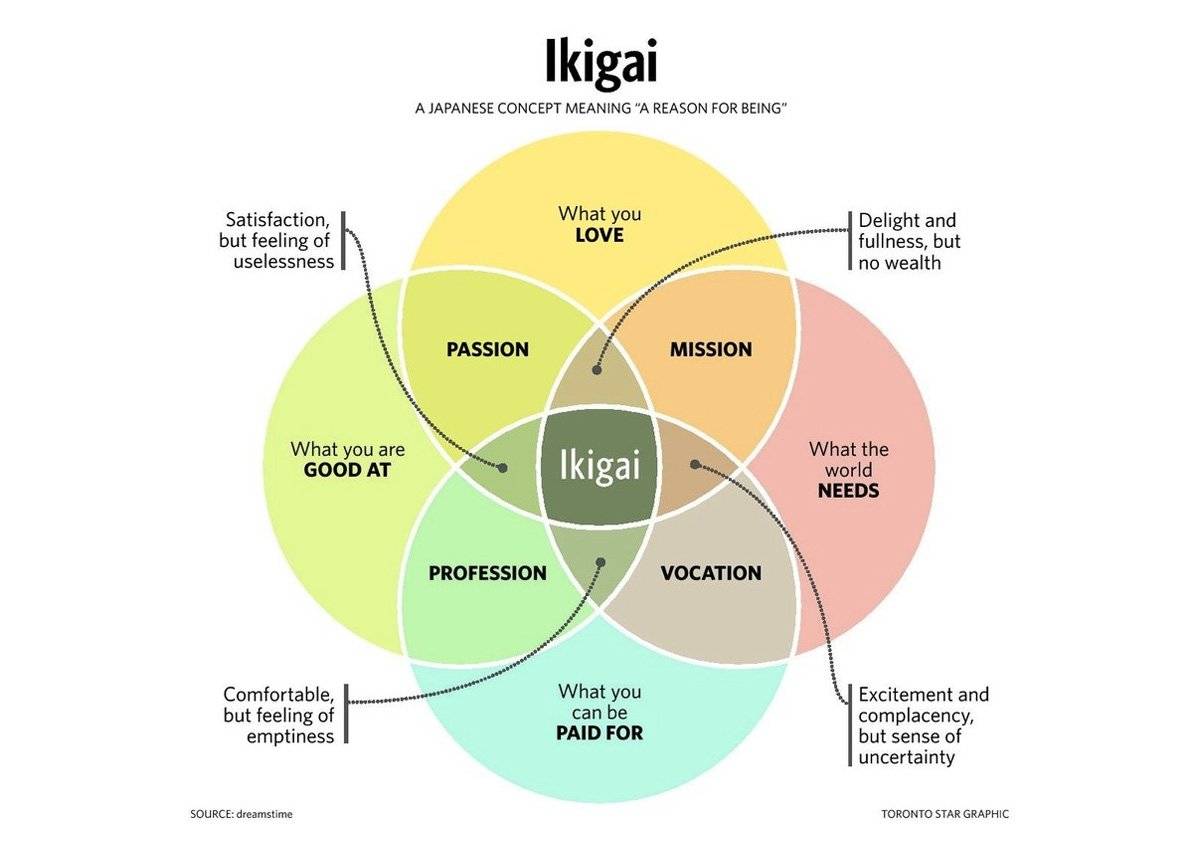
Finding life's purpose with Ikigai

-Discovering your life's purpose through Ikigai is associated with increased income, better health, and a happier life.

-Ikigai is a Japanese concept that combines passion, mission, vocation, and profession.

-Identify your Ikigai by answering four key questions: what you love, what you are good at, what the world needs from you, and what you can get paid for.

-Ikigai may evolve with age and circumstances, guiding you towards a fulfilling life.